AI meeting notes for accountants, filed on the client
The Nagaris notetaker joins your meetings and writes them up with a summary and actions, then files the notes, transcript and recording on the client. It costs $3 a meeting hour, not a monthly seat for everyone.
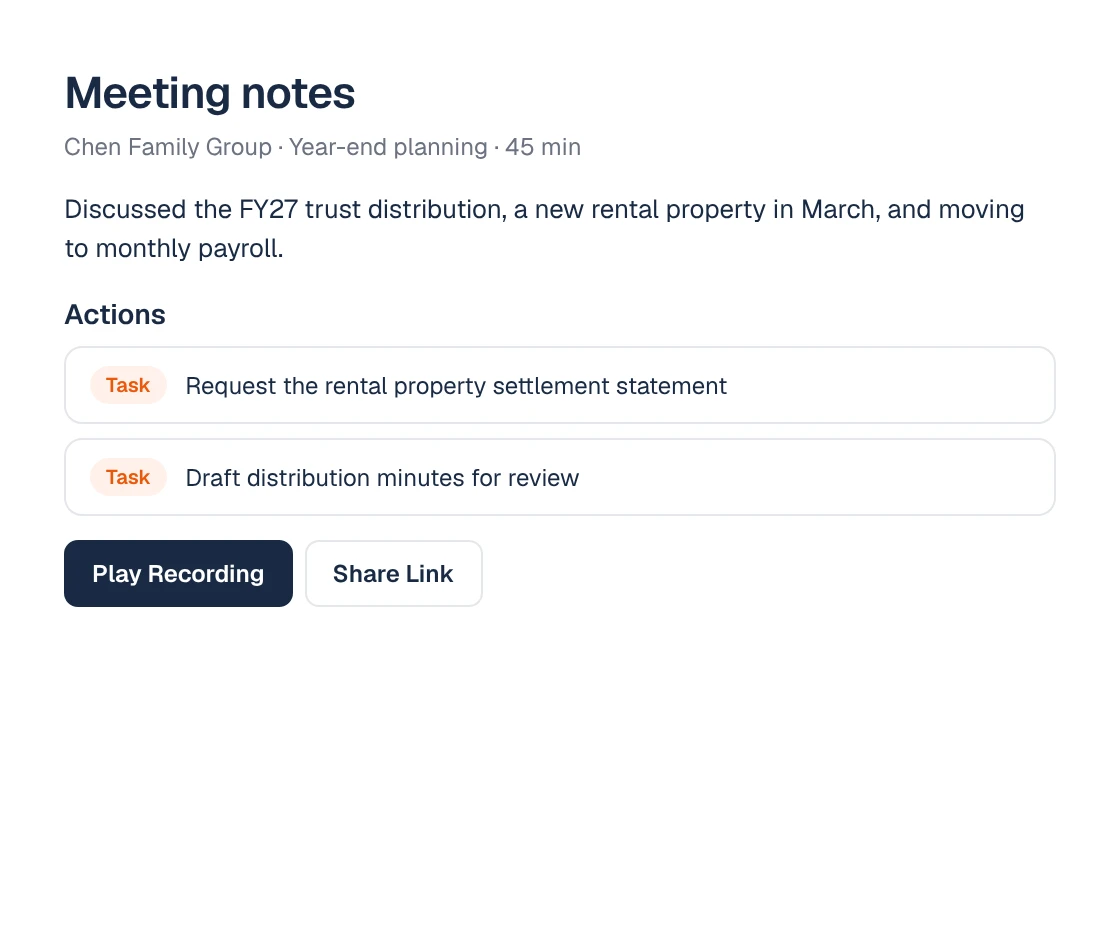
What it does
A tax planning meeting can cover a dozen decisions: a distribution, a super contribution, a question for the lawyer. The accountant runs the meeting and takes notes at the same time, and something gets lost.
The Nagaris notetaker joins your meetings and writes them up. When the meeting ends, the summary and the actions are ready. The recording, transcript, notes and actions land on the client, not in another app, and calls and meetings sit together on the client's timeline.
- Notes written. A summary and the actions, ready when the meeting ends.
- Keep the video. Play it back on the client, or share it by link.
- Filed on the client. Notes, actions and the recording sit on the client record.
- Pay by the hour. $3 a meeting hour, not a monthly seat for everyone.
Who it's for
Partners and managers who run advisory, year-end and planning meetings and want to stay in the conversation instead of typing. It also suits firms where only some people hold client meetings, since you pay for meeting hours used rather than a seat for every staff member.
What your meeting notes need to show
For tax practitioners, a meeting note is a compliance record. Section 30 of the Code Determination requires records that correctly record the tax agent services provided, and the TPB says those records must include all advice received from and provided to the client, in writing and orally (TPB(GS) 52/2024). Where advice is given verbally, the TPB notes you may need to make a record, such as a file note, before you can keep it.
Records must be kept for at least 5 years after the service is provided. The TPB does not expect every detail recorded, but the record should show the nature, scope and outcome of the service. Read the AI summary before relying on it. A note that records advice that was not given, or misses advice that was, is worse than no note.
Recording a meeting: consent by state
Listening device laws are state and territory laws, and they differ. In plain terms, as at 23 October 2026:
| Where | Law | Can a participant record without everyone's consent? |
|---|---|---|
| NSW | Surveillance Devices Act 2007, s 7 | Generally no. Allowed with consent of all principal parties, or if one consents and it is reasonably necessary to protect their lawful interests, or not made to share with non-parties. |
| ACT | Listening Devices Act 1992, s 4 | Generally no. Similar exceptions to NSW. |
| Tasmania | Listening Devices Act 1991, s 5 | Generally no. Similar exceptions to NSW. |
| WA | Surveillance Devices Act 1998, s 5 | Generally no. Allowed with consent of each principal party, or one party's consent where reasonably necessary to protect their lawful interests. |
| SA | Surveillance Devices Act 2016, s 4 | Generally no. Allowed with consent of all principal parties, or where reasonably necessary to protect the recorder's lawful interests. |
| Victoria | Surveillance Devices Act 1999, s 6 | The offence covers recording a conversation you are not a party to without consent. A participant is not caught by it. |
| Queensland | Invasion of Privacy Act 1971, s 43 | The offence does not apply to a party to the conversation. Section 45 limits sharing the recording. |
| NT | Surveillance Devices Act 2007, s 11 | The offence covers recording by a non-party. Section 15 limits communicating or publishing a record. |
A notetaker that joins a call is arguably not a "party" in the ordinary sense, and online meetings often span states. The simple, safe practice is the same everywhere: tell everyone at the start that the meeting is being recorded and transcribed, get their agreement, and note it. Put consent to recording in your engagement letter as well, and confirm it on the call.
Privacy and AI
Recordings hold personal and often financial information. Under APP 11, an APP entity must take reasonable steps to protect personal information it holds from misuse, interference and loss, and from unauthorised access, modification or disclosure. The TPB also expects clients to be told where data is stored and whether AI is used. Nagaris stores client data in Australia on AWS Sydney servers and is ISO 27001 certified. See the AI for accounting firms guide for consent wording.
How it fits with the rest of Nagaris
Because notes land on the client file, Ask Nagaris can use them when it answers questions or drafts the follow-up email, with your sign-off before anything goes. Calls through Nagaris Phone are recorded and written up, and sit on the same timeline. The team picks up actions in the client's room in Client Rooms, and Time Tracker drafts each person's day from their desktop, email and calendar, so meeting time is not forgotten.
Price
$3 a meeting hour for recording, transcript, notes and actions.
Questions
What does the notetaker produce?
A recording, transcript, summary and list of actions, ready when the meeting ends.
How is it priced?
$3 a meeting hour, rather than a monthly seat for everyone in the firm.
Where are the notes kept?
On the client, with the recording, alongside their calls and other activity on the client's timeline.
Can I share a meeting recording?
Yes. You can play the video back on the client or share it by link.
Can Ask Nagaris use meeting notes?
Ask Nagaris works across what is on the client file, so it can draw on the notes when answering questions or drafting emails, with your sign-off before anything is sent.
Do I need consent to record a client meeting?
In NSW, the ACT, Tasmania, WA and SA, recording a private conversation you are part of generally needs the consent of all principal parties, subject to limited exceptions. The simple practice everywhere is to tell everyone and get their agreement at the start.
What meeting notes does a tax agent have to keep?
Records must show the services provided, including all advice received from and given to the client, in writing and orally. They must be kept for at least 5 years after the service is provided.
Sources
- Surveillance Devices Act 2007 (NSW)
- Surveillance Devices Act 1999 (Vic) s 6
- Invasion of Privacy Act 1971 (Qld)
- Surveillance Devices Act 1998 (WA)
- Surveillance Devices Act 2016 (SA)
- Listening Devices Act 1991 (Tas)
- Listening Devices Act 1992 (ACT)
- Surveillance Devices Act 2007 (NT), as in force 1 June 2026
- TPB(GS) 52/2024 Obligation to keep proper client records
- TPB, Obligation to keep proper client records
- TPB(GS) 55/2026 The use of Artificial Intelligence and the Code of Professional Conduct
- OAIC: Australian Privacy Principles quick reference
See Nagaris in action
Leave your details and we will set up a 30-minute walk-through with your own clients and questions.