AML/CTF software for accounting firms
AML/CTF software helps an accounting firm run customer due diligence, PEP and sanctions screening, risk ratings, ongoing reviews and record keeping for designated services. It supports, but cannot replace, the firm's own AML/CTF program and judgement.
Since 1 July 2026, accounting firms that provide certain services have been reporting entities under the AML/CTF Act. Software can carry a lot of the day-to-day load: collecting client details, verifying identity, screening, recording the risk rating and reminding you when a review is due. It cannot be your AML/CTF program, make your risk decisions or lodge your judgement for you. This page maps each obligation to what a system can and cannot do, gives a buyer's checklist, and shows how Nagaris handles a real client.
What the law asks of the firm
The obligations attach to designated services, such as setting up a company or trust, acting on the sale of a business or real estate, or holding client money for a transaction. Routine tax returns and BAS are not on the list. The Tranche 2 AML guide covers which services are in scope. Once a firm provides one, AUSTRAC's factsheet for tranche 2 reporting entities sets out the core duties.
| Obligation | What the rule says | What software can do | What stays with the firm |
|---|---|---|---|
| Enrolment | Enrol with AUSTRAC within 28 days of first providing a designated service (typically 29 July 2026 for services from 1 July 2026). Update details within 14 days of a change. | Track which clients received a designated service and when | Enrolling, keeping details current |
| AML/CTF program | A risk assessment plus policies, approved by senior management and overseen by the governing body. Kept up to date after significant changes. | Hold the program, record approvals, apply its rules in the client flow | Writing it, approving it, owning it |
| Compliance officer | Appoint an AML/CTF compliance officer to oversee day-to-day compliance and deal with AUSTRAC. | Assign the role, route reviews and alerts to that person | Choosing the right person and giving them authority |
| Initial CDD | Generally completed before you provide the designated service: identify and verify the customer, people acting for them, beneficial owners, PEP status, targeted financial sanctions, the nature and purpose of the relationship, and the customer's ML/TF risk. | Collect KYC, verify ID, map ownership, screen, suggest a rating | Deciding the rating and whether to act |
| Enhanced CDD | Required when the customer's ML/TF risk is high, or in other specified circumstances. | Trigger extra questions such as source of wealth when risk is high | Assessing the answers |
| Ongoing CDD | Keep KYC current, monitor for unusual behaviour, update the risk rating as you learn more. | Schedule reviews, re-screen, flag changes | Noticing what a system cannot see in conversations and files |
| Suspicious matter reports | Within 24 hours of forming a suspicion for terrorism financing, otherwise within 3 business days. | Capture internal reports, timestamp them, restrict who can see them | Forming the suspicion and lodging with AUSTRAC |
| Tipping off | A criminal offence to disclose certain information where it would or could reasonably be expected to prejudice an investigation (up to 2 years imprisonment or 120 penalty units, or both). | Limit access to SMR records and keep them off the client view | Staff training and conduct |
| Threshold transactions | Physical currency of A$10,000 or more (or the foreign currency equivalent), reported within 10 business days after the day of the transaction. | Record the transaction | Reporting it |
| Records | Most records kept for 7 years. | Store CDD records, screening results and decisions with an audit trail | Setting and following a retention policy |
| Independent evaluation | At least once every three years, and in certain other circumstances. | Produce the records an evaluator asks for | Commissioning the evaluation |
Sources: AUSTRAC factsheet for tranche 2 reporting entities, AUSTRAC CDD overview, AUSTRAC tipping off guidance.
A buyer's checklist for AML software
Most firms will see demos that look alike. These questions, worked out from the obligations above, separate a tool that helps from one that adds another screen to check.
How Nagaris does it
Nagaris runs AML inside client onboarding, so it is one flow, not a second system.
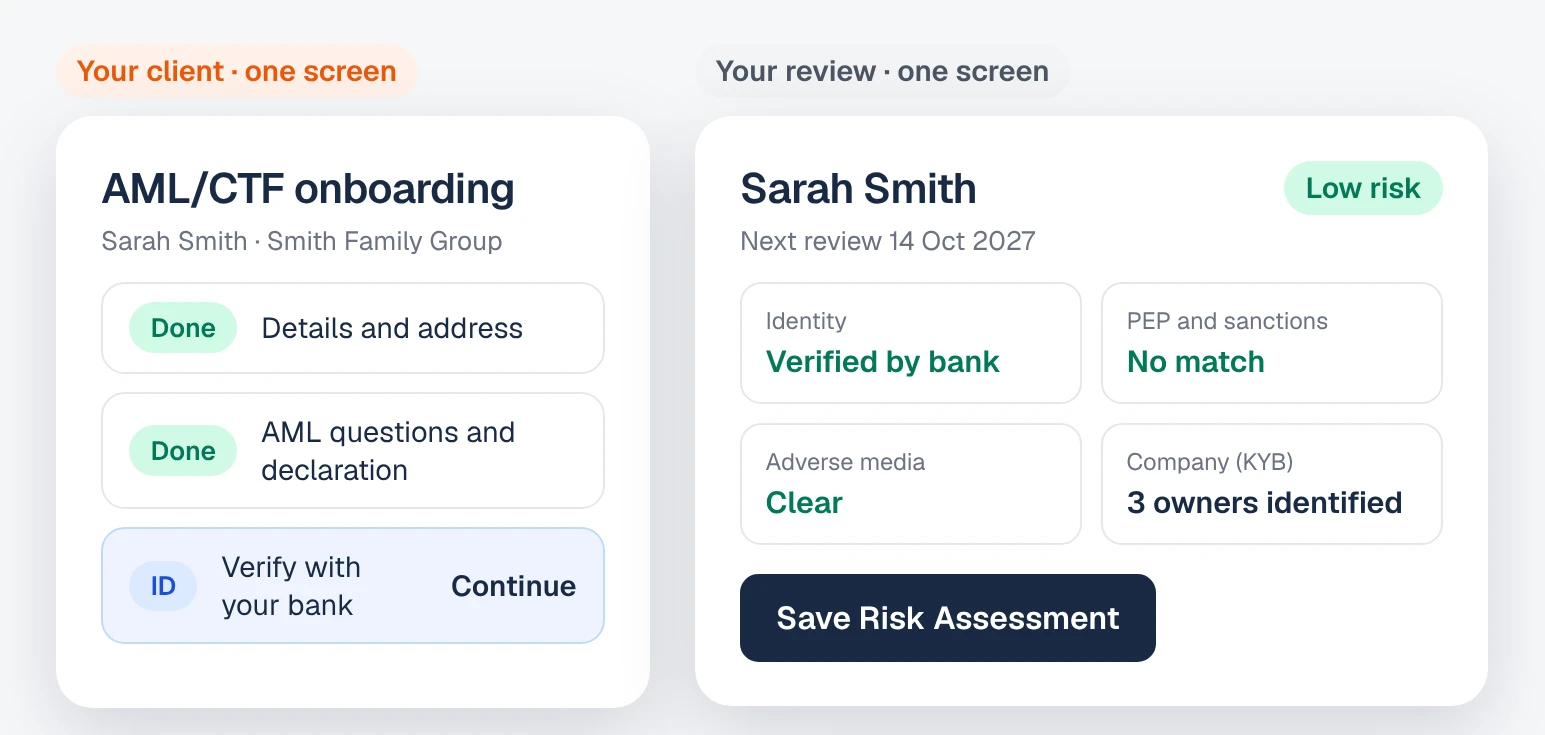
- One screen for the client. Details, AML questions and the declaration on one form on their phone, then ID verified through their bank with ConnectID, or with photo ID and a selfie.
- One screen for you. ID result, PEP, sanctions and adverse media screening and company checks side by side.
- Risk assessed with you. Risk factors fill in from screening and answers. You confirm the rating and the next review date is set.
- Structured ML/TF risk assessments with enhanced CDD and source-of-wealth capture.
- Company checks (KYB). ASIC extracts, directors, beneficial owners and credit checks, with beneficial ownership mapping for corporate structures.
- Ongoing monitoring with automated review scheduling.
- Internal unusual activity reporting with tipping-off safeguards.
- Designated services classification and staff AML role assignment with training progress tracking.
- Every action is timestamped. Client data is stored in Australia on AWS Sydney servers, and Nagaris is ISO 27001 certified.
AML risk assessments and PEP and sanctions screening are included in every plan. ID checks are $5 a person. Company checks are $9 to $49 a company.
Worked example: setting up a family trust
Mei and David Tran ask the firm to set up a discretionary trust with a corporate trustee to buy an investment property. Creating a trust and a company are designated services, so initial CDD comes first.
- Classify. The engagement is marked as including designated services. Their annual tax returns, done for years, are not.
- Collect. Mei and David each get one form on their phone, answer the AML questions and verify ID through their bank.
- Map the structure. For the trust, the people AUSTRAC lists are recorded: the trustee company and its beneficial owners, the settlor, the appointor, and the class of beneficiaries. The company check pulls directors and shareholders.
- Screen. Both are screened for PEP status, sanctions and adverse media. Nothing comes back.
- Rate. The suggested rating is low. The reviewer confirms it, notes the purpose (property investment) and the next review date is set.
- Proceed. Only now does the firm register the company and settle the deed.
Had David been a politically exposed person, the PEP result would have pushed the rating up and asked for source of wealth before the work started. The customer due diligence checklist lists every item, and the Tranche 2 readiness checklist covers the program side.
What software will not do for you
No tool forms a suspicion, approves your program or decides which clients your firm will act for. AUSTRAC's guidance also says your program's CDD policies must suit the ML/TF risks your firm actually faces, which means the settings in any system come from your own risk assessment, not the vendor's defaults. Buy software that records your judgement well. Do not buy one that claims to replace it.
Questions
What is AML/CTF software for accountants?
It is software that collects and verifies client identity, screens for PEPs and sanctions, records a risk rating and schedules reviews, so a firm can meet its customer due diligence obligations for designated services.
Do all my clients need AML checks?
No. The obligations attach to designated services such as creating companies or trusts or acting on a business or property sale. A client who only receives tax returns or BAS is not receiving a designated service.
Can software make my firm compliant?
No. Software supports your AML/CTF program with checks and records. The firm still needs its own program, compliance officer, risk decisions and reporting.
When must customer due diligence be done?
Generally before you start providing the designated service, then on an ongoing basis for the life of the relationship, according to AUSTRAC.
How long must AML records be kept?
AUSTRAC's factsheet says most records must be kept for 7 years.
How quickly must a suspicious matter be reported?
Within 24 hours of forming the suspicion for terrorism financing, and within 3 business days otherwise.
What does Nagaris charge for AML checks?
Risk assessments and PEP and sanctions screening are included in every plan. ID checks are $5 a person and company checks are $9 to $49.
How do clients verify their identity in Nagaris?
On their phone, through their own bank with ConnectID, or with photo ID and a selfie.
Sources
- AUSTRAC: AML/CTF obligations factsheet for tranche 2 reporting entities
- AUSTRAC: Overview of customer due diligence (last updated 13 October 2026)
- AUSTRAC: Initial CDD for trust
- AUSTRAC: Persons designated for targeted financial sanctions
- AUSTRAC: Tipping off
- AUSTRAC: Professional designated services (table 6)
See Nagaris in action
Leave your details and we will set up a 30-minute walk-through with your own clients and questions.