Client onboarding software for accounting firms
Client onboarding software for accountants runs ID verification, AML checks where needed, the engagement letter, payment setup and document collection as one flow, then creates the jobs. Nagaris does this from the ABN to the first task, with the client finishing their part on a phone.
Client onboarding is the stretch between a new client saying yes and your team starting work. In that window an Australian firm has to decide whether to accept the client, verify identity, agree terms in writing and, for some services, complete AML/CTF due diligence. Software helps most when it runs those steps as one flow, in the right order, with a record of each. This page sets out what the rules require, how to evaluate onboarding software, and how Nagaris runs it.
What the rules require at onboarding
| Step | Rule | Key points |
|---|---|---|
| Verify identity | TPB(GS) 42/2022 | Verify every new client and any representative before providing tax or BAS services, with evidence of the representative's authority. Related clients are each verified separately (para 12). |
| Keep the right record | TPB(GS) 42/2022 paras 24 to 26 | The TPB does not require copies of ID. Record the date and time, who checked, what was sighted and how. Keep it at least five years after the engagement ends. Ordinary email is not recommended for ID documents. |
| AML/CTF due diligence | AML/CTF Act, from 1 July 2026 | For designated services, complete initial CDD before the service starts: identity, beneficial owners, PEP and sanctions status, and the client's ML/TF risk. |
| Agree terms | APES 305; TPB Code s 45 | Document and communicate the terms of engagement. Registered agents also give the section 45 information in writing on engagement. |
The client onboarding guide covers each step in depth, including professional clearance, TFNs and ATO and ASIC authority.
Where AML onboarding fits
AML/CTF obligations apply to designated services, such as creating companies and trusts or acting on a business sale, not to routine returns. When a new client needs one of those services, AUSTRAC says initial CDD generally comes before you start. The practical answer is to run AML questions and ID verification inside onboarding, so a client who needs CDD does it in the same sitting as signing. See AML/CTF software for the full obligation map.
A buyer's checklist for onboarding software
How Nagaris does it
- Start from the ABN. Entity details fill themselves in from the ABR.
- One engagement for the group. Every entity on one group proposal.
- Sign and pay. The client clicks Accept, signs and sets up payment in the same step.
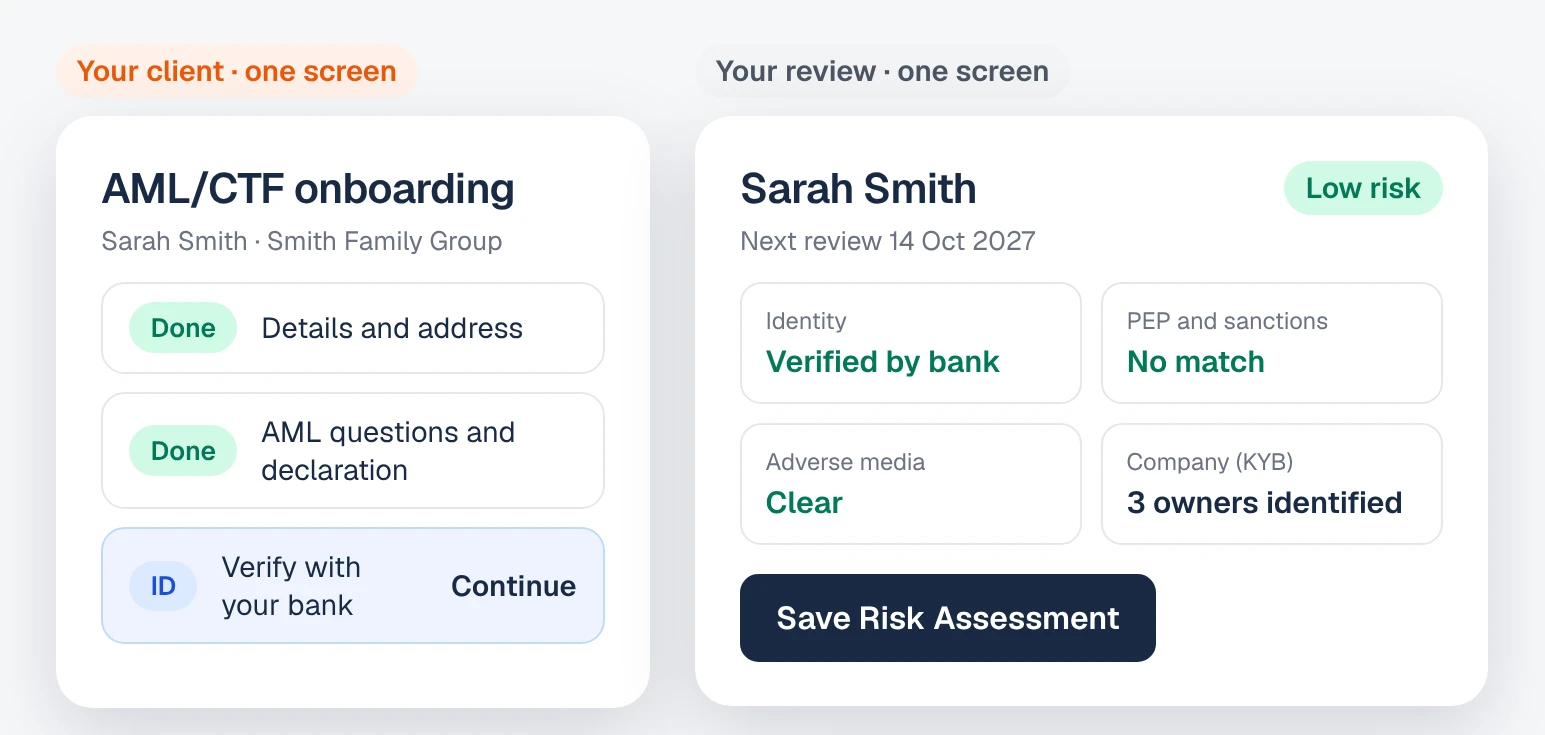
- Verify ID and AML. One form on the phone for details, AML questions and the declaration, then ID through their bank with ConnectID or with photo ID and a selfie. You see the ID result, PEP, sanctions and adverse media screening on one screen and confirm the risk rating.
- Multiplayer mode. You fill in what you know and the client completes the rest through a guided portal: TFN, documents, accounting software and ATO portal link, each with a step-by-step wizard. TFN Self-Service gives them five ways to find their TFN without calling you.
- Work starts. Jobs, services, budgets and tasks are created from the engagement and assigned in your team's queue.
Clients log in without a password, through Xero, Apple, Google, Microsoft or a one-time email link. Every night Nagaris checks your records against XPM, CAS 360 and SF360 and helps you fix differences, and a duplicate finder merges the same person XPM created once per client. Client data is stored in Australia on AWS Sydney servers and Nagaris is ISO 27001 certified.
Onboarding is part of every plan, from $495 a month. ID checks are $5 a person, company checks from $9, and signatures $1 a document. Most firms are up and running on the same day.
Questions to ask in a demo
Ask the provider to onboard a real family group from your books in front of you: two individuals, a trust with a corporate trustee and an SMSF. Count how many times a name or address is typed, how many messages the client receives, and whether the identity record for each person would satisfy the TPB guidance without a copy of their licence sitting in a folder. Then ask what happens the next morning. If the new jobs are not in your team's queue and the entities are not in your practice manager, the onboarding is not finished.
Worked example: a new client buying a business
Priya Shah moves to the firm with her company, Shah Dental Pty Ltd, and wants help buying a second practice.
- The partner enters the company ABN. Details fill in from the ABR.
- The engagement covers Priya's return, the company's compliance work and the acquisition. The acquisition is a designated service, so AML is switched on for this client.
- Priya signs on her phone, sets up direct debit, completes the AML form and verifies ID through her bank. The company check pulls directors and beneficial owners.
- Screening is clear. The reviewer confirms a low rating and the review date is set.
- Priya adds her TFN and uploads last year's financials in the portal. A clearance letter goes to her previous accountant.
- Jobs for all three pieces of work land in the team's queue the same day.
Use the new client checklist to make sure nothing is missed, and the professional clearance letter template, adapted and reviewed by your firm, for the handover.
Questions
What should accounting client onboarding include?
An acceptance decision, identity verification of each client and representative, a documented engagement, and for designated services, AML/CTF customer due diligence before the work starts.
Do I need to keep copies of client ID?
The TPB does not require or recommend keeping copies. It asks for a record of when the check was done, by whom, what was sighted and how, kept at least five years after the engagement ends.
What is AML onboarding?
Running AML/CTF customer due diligence, such as ID verification, PEP and sanctions screening and a risk rating, as part of onboarding for clients who receive designated services.
Can clients complete onboarding themselves in Nagaris?
Yes. You fill in what you know and the client completes the rest through a guided portal, including TFN, documents, accounting software and ATO portal link.
Do clients need a password?
No. They log in through Xero, Apple, Google, Microsoft or a one-time email link.
How long does it take to go live?
Most firms are up and running on the same day. Connecting XPM takes minutes and existing clients sync automatically.
Where is client data stored?
In Australia, on AWS Sydney servers. Nagaris is ISO 27001 certified.
Sources
- TPB(GS) 42/2022 Proof of identity requirements for client verification
- AUSTRAC: Overview of customer due diligence (last updated 13 October 2026)
- APESB: Terms of Engagement (APES 305, effective 1 January 2025)
- Tax Agent Services (Code of Professional Conduct) Determination 2024, Compilation No. 4 (1 October 2026)
- AUSTRAC: AML/CTF obligations factsheet for tranche 2 reporting entities
See Nagaris in action
Leave your details and we will set up a 30-minute walk-through with your own clients and questions.