Engagement letter and proposal software for family groups
Engagement letter software should produce letters that meet APES 305 and the TPB Code's section 45, handle family groups with each entity scoped and priced, collect signatures and start the work. Nagaris puts the whole group on one engagement that the client signs once.
Engagement letter software does one job well or badly: it turns what you agreed with a client into a written, signed record that meets your professional obligations, then starts the work. For most Australian firms the client is a family group, not a single taxpayer, and that is where many tools struggle. This page covers what the standards require of the letter, how to judge software against them, and how Nagaris handles a group.
What the standards require
APES 305 Terms of Engagement
APES 305 (2024), effective 1 January 2025, applies to CPA Australia, CA ANZ and IPA members in public practice. Its mandatory core is short: document the terms of engagement and communicate them to the client, comply with the Code's confidentiality requirements, and, where you use outsourced services, document and communicate the provider, where the work is done and what it covers. Section 4 is a guide to matters most engagement documents should consider, such as purpose, scope, outputs, each party's responsibilities, ownership of documents and data, and any limitation of liability under a professional standards scheme. The engagement letters guide works through each paragraph.
Code of Professional Conduct, section 45
For registered tax and BAS agents, section 45 of the Tax Agent Services (Code of Professional Conduct) Determination 2024 requires you to tell current and prospective clients in writing, in a prominent, clear and unambiguous way, about:
- the TPB register and how to search it
- how to complain, including the Board's complaints process
- your rights, responsibilities and obligations under the taxation laws, and the client's obligations to you
- certain events in the last five years, such as suspension or termination of registration
- any current conditions on, or suspension of, your registration
The first three items are given on engagement or re-engagement, or on request. The Determination's example says publishing the information on your website, including it in engagement and re-engagement letters, and giving each client the Board's factsheet on general information for clients will meet the requirement. Section 30 separately requires client records showing the nature, scope and outcome of each service, kept for at least 5 years.
Related clients and family groups
The TPB's letters of engagement page says you should issue separate letters for each client, unless agreed otherwise, for related parties such as a company and its directors or the trustees of a trust and its beneficiaries. It also recommends reviewing recurring engagements regularly, preferably annually. So a group engagement still has to treat each entity as its own client: its own services, its own fees, its own acceptance. Good software makes that easy inside one document and one signing step rather than five separate packs.
A buyer's checklist for engagement letter software
How Nagaris does it
- Group-first engagement. Trusts, companies, SMSFs and individuals on one proposal and one engagement letter.
- ABR prefill. Type the ABN and the entity details fill themselves in.
- Flexible pricing and billing. Price the group as one package, entity by entity, or any combination. The group pays together, entity by entity, or on your own split.
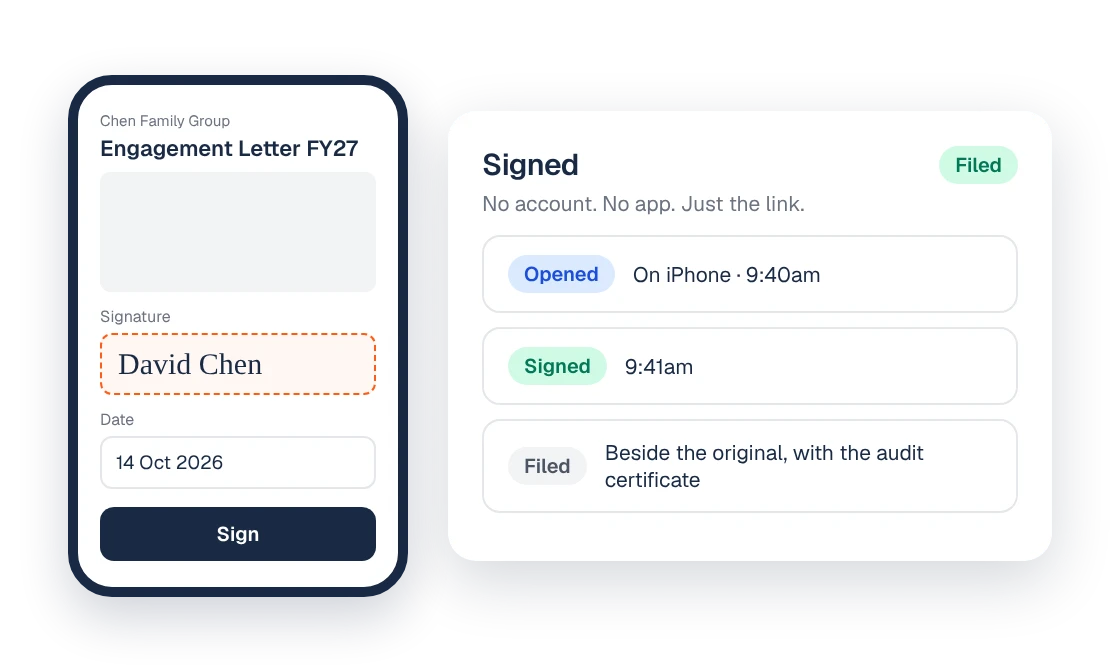
- One signature. Clients sign once for the entire group, on their phone, with no account or app.
- The signature starts the work. The client signs and sets up payment in the same step. Jobs, services, budgets and tasks are created from the proposal line items and land in your team's queue, in XPM or straight from the engagement. Every action is timestamped.
- Rapid Rollover. Copy last year's engagement in one click and it's ready as a draft.
- Ethical clearance letters are included in every plan.
There's no fee per proposal or per client. Plans include unlimited users and engagements: Launch is $495 a month for up to 500 active clients, Growth $1,595 for up to 2,000, and Scale $2,995 for up to 5,000. Yearly billing saves 20%. E-signatures are $1 a document. Donagh Chisholm of Chisholm Accounting sent six ethical letters on his first day using Nagaris.
Worked example: the Nguyen family group
The group is Anh and Linh Nguyen, the Nguyen Family Trust, Nguyen Holdings Pty Ltd as trustee, and the Nguyen Super Fund.
- Build. Enter the ABNs. Entity details fill in from the ABR. All five go on one engagement.
- Scope each client. Individual returns for Anh and Linh, the trust return and distribution minutes, the company return and ASIC annual review, the SMSF accounts and return. Each line sits under its own entity.
- Price. The family sees one group fee with the per-entity split shown, and the trust and company are billed to the trust.
- Standard wording. Your APES 305 terms and section 45 information sit in the letter for every entity.
- Sign and pay. Anh and Linh sign once on their phones and set up direct debit.
- Work starts. Jobs for all five entities appear in the team's queue. Next year, Rapid Rollover copies the engagement as a draft for review.
Common gaps when firms switch
Three problems come up again and again when firms review their existing letters against the rules. The section 45 information sits on the website but not in the letter, so re-engagements go out without it. Recurring clients are rolled over for years without anyone reviewing scope, even though the TPB suggests an annual review. And the scope in the letter does not match the jobs in the practice manager, so work is done that was never agreed or billed. Software that builds the jobs from the signed scope, and copies last year's engagement as a draft rather than a final, closes all three.
Start from the family group engagement letter template or the engagement letter template. Both need to be adapted and reviewed by your firm.
Questions
What must an accountant's engagement letter include?
APES 305 requires the terms to be documented and communicated, with confidentiality obligations met and details of any outsourced services disclosed. Registered agents also need the section 45 information, such as the TPB register and complaints process.
Can one engagement letter cover a whole family group?
It can, provided each entity is treated as its own client with its own scope, fees and acceptance. The TPB says separate letters should be issued for related parties unless agreed otherwise, so check how your document handles each entity.
How often should engagement letters be reissued?
The TPB suggests reviewing recurring engagements regularly, preferably annually, and issuing a new letter when scope, terms, law or the client's circumstances change.
Do clients need an account to sign in Nagaris?
No. Clients sign on their phone with no account or app, and sign once for the entire group.
Does Nagaris charge per proposal?
No. Plans include unlimited users and engagements, from $495 a month. E-signatures are $1 a document.
What happens after the client accepts?
They sign and set up payment in the same step, and jobs, budgets and tasks are created from the proposal line items in your team's queue.
Is there proposal software that works with XPM?
Nagaris creates jobs in XPM from the engagement, with changes in Nagaris appearing in XPM within seconds.
Sources
See Nagaris in action
Leave your details and we will set up a 30-minute walk-through with your own clients and questions.